
Why Does My Child Only Behave Badly Around Me? The Science Behind After-School Meltdowns and Big Feelings


"Your child is an absolute angel at school."
If you've ever heard those words from a teacher and wondered whether they accidentally mixed your child up with someone else, welcome to being a parent.
We all know the feeling. Your child spends the day listening, sharing, following instructions, and generally being described as "a pleasure to have in class." Then they get home and have a complete meltdown.
It's confusing. How can the same child who seems calm, polite, and cooperative at school become emotional, argumentative, or overwhelmed at home?
This is often a normal part of child development. In many cases, it has far less to do with bad behaviour and much more to do with how children cope with the demands of their day.
Researchers who study child development, emotional regulation, and attachment have found that children don't behave the same way in every environment. Just as adults act differently at work, at home, and with close friends, children adjust their behaviour depending on where they are, who they're with, and what is expected of them.
The thing is, we often don’t realise how much of a child's day is spent managing emotions, attention, impulses, and social situations. By the time children get home, some have very little left in the tank.
This is why after-school meltdowns, sudden tears, irritability, and emotional outbursts are so common, especially in preschool and primary school-aged children.
In this article, we'll look at why children often behave differently at home than they do at school, what science tells us about after-school meltdowns, why parents sometimes see the biggest emotions, and when behaviour might be a sign that something more needs attention.
You may never look at that post-school banana-related meltdown quite the same way again.
Quick Answer: Why Does My Child Only Behave Badly Around Me?
Children often behave differently at home than they do at school because home is a different environment with different demands, relationships, and expectations. By the end of the day, many children are more emotionally sensitive and less able to cope with frustration than they were earlier that morning.
This can lead to what is called an after-school meltdown, where children seem more emotional, irritable, sensitive, or argumentative than they were earlier in the day. Parents also tend to see a child's biggest feelings because they are usually the people children turn to when they are overwhelmed, frustrated, tired, or upset.
That doesn't mean children should be allowed to behave however they want. Boundaries are still important. But understanding why these emotional explosions happen can help you respond more effectively and worry less that they're somehow doing something wrong.
If your child seems perfect at school but difficult at home, you're certainly not the only parent asking why.

What Is an After-School Meltdown?
Your child gets into the car after school. You ask how their day was. They shrug. You offer them a snack. They burst into tears because it wasn't the snack they wanted. These things can seem completely irrational. How can such a small problem cause such a big reaction?
An after-school meltdown is an emotional outburst that happens after a child has spent the day managing the many demands of school. It can look like crying, shouting, arguing, clinginess, defiance, or becoming upset over things that normally wouldn't bother them.
Some experts also refer to this phenomenon as after-school restraint collapse, a term used to describe children who appear to hold things together during the school day before releasing their emotions once they return home.
What makes these meltdowns so confusing is that the trigger is often tiny. The problem isn't really the banana. Or the socks. The trigger is simply the final straw.
Psychologists sometimes describe this as a "stacking" effect. Throughout the day, children experience dozens of small frustrations, disappointments, challenges, and sensory demands. Most are handled successfully in the moment, but they don't necessarily disappear.
A noisy classroom. A friendship disagreement. A difficult maths lesson. An unexpected change in routine. A lunchbox that wasn't quite filling enough. None of these may seem significant on their own. Together, however, they can gradually build emotional pressure beneath the surface.
Think of it like carrying shopping bags.
One bag is easy. Two bags are manageable. By the time you're carrying ten bags, even adding a loaf of bread can feel like too much. Children experience something similar with emotions.
The tears over a minor inconvenience often aren’t about the inconvenience at all. They're about everything that came before it. This is one reason parents are often surprised when teachers report that a child had a perfectly good day.
I’m not saying you should excuse poor behaviour or suggesting that children have no responsibility for their actions. But understanding this helps explain why reactions can sometimes seem so out of proportion to the situation in front of them.
The Brain Skill Behind Good Behaviour
When we describe a child as "well-behaved", what do we actually mean?
Usually, we're talking about a child who can wait their turn, listen to instructions, manage disappointment, control impulses, stay focused, and recover when things don't go their way. The interesting part is that these aren't personality traits. They're skills.
Child development experts refer to many of these abilities as self-regulation, the brain's ability to manage emotions, behaviour, attention, and impulses in order to meet the demands of a situation.
It's one of the most important skills children develop, and one of the easiest to overlook.
Imagine you're in a meeting. You disagree with something that's being said, but you wait for your turn to speak. Your phone buzzes, but you ignore it. You're hungry and a little irritated, but you stay polite. Most adults don't think twice about these actions because self-regulation has become automatic.
For children, however, these same tasks require active effort. Every day, children are expected to:
Sit still when they would rather move.
Listen when something else is more interesting.
Follow the rules they didn't create.
Wait for things they want right now.
Cope with disappointment.
Share attention with dozens of other children.
Manage frustration without falling apart.
And they do this while their brains are still developing.
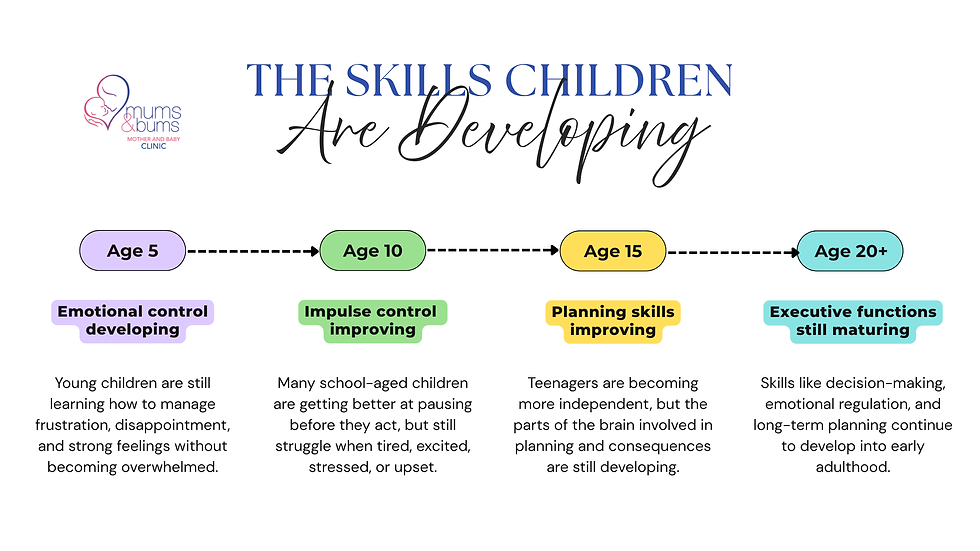
In fact, the parts of the brain involved in planning, attention, emotional control, and impulse management continue developing well into early adulthood. This means that young children often have to work much harder than adults to achieve what appears to be simple self-control.
Research shows that self-regulation is linked to social, emotional, and academic outcomes throughout childhood. In other words, the ability to pause, adapt, focus, and recover from setbacks matters far beyond the classroom.
But self-regulation isn't something children either have or don't have. It's a skill that develops over time. Some days it works beautifully. Other days, especially when a child is hungry, tired, overwhelmed, excited, worried, or unwell, it becomes much harder to access.
Instead of viewing emotional outbursts as a child choosing to be difficult, it can be helpful to recognise that the brain systems responsible for managing emotions and impulses are still very much under construction.
This means that behaviour is often a reflection of skills that are still developing, rather than a reflection of character. And once you understand that, those after-school meltdowns start to look very different.

Why Do Children Save Their Biggest Feelings for Their Parents?
One of the most common frustrations parents have is: "Why does my child behave perfectly for everyone else and then fall apart the moment they're with me?" After all, if your child can control their emotions at school, why can't they do the same thing at home? The answer may lie in a concept that developmental psychologists call co-regulation.
Most adults think of emotional regulation as something we do independently. We calm ourselves down, manage our stress, and work through difficult emotions using skills we've developed over many years.
Children are different. Their ability to regulate emotions is still developing, which means they often rely on trusted adults to help them manage feelings that are too big to handle alone. This process is known as co-regulation.
In simple terms, children "borrow" emotional support from the adults they trust most.
Think about what many children do when they're hurt, frightened, embarrassed, overwhelmed, or disappointed. They don't usually seek out the nearest adult. They look for a specific person. A parent. Someone they trust.
Attachment researchers describe this as a secure base and a safe haven. Children naturally move away from caregivers to explore the world, then return when they need comfort, reassurance, or support.
What's fascinating is that this doesn't only happen during obvious moments of distress. It can happen after an ordinary day. A child may spend hours absorbing new information, coping with challenges, and handling small frustrations. Then they return to the people their brain associates with safety and support.
This doesn't mean children consciously save their worst behaviour for their parents. They're not thinking: "I've been good all day. Now I'm going to make life difficult for Mum." They're often responding instinctively to the people they trust to help them process emotions.
One study of attachment found that securely attached children are more likely to seek comfort and support from caregivers when distressed. In other words, strong attachment relationships don't eliminate difficult emotions. They provide a place for those emotions to be expressed and worked through.
Your child is not manipulating you. And they are certainly not proving that their teacher has discovered some secret parenting technique. Very often, they are turning toward the people their brain expects to help them feel safe, understood, and regulated again.
Of course, this doesn't mean parents should accept aggressive, hurtful, or unsafe behaviour. Children still need consequences when appropriate. But understanding the role of attachment can help you see this behaviour differently.
Sometimes, the child who seems hardest to manage is not showing you their worst side. They may be showing you the side they trust you to help them carry.
Why Does My Child Behave Differently With Different People?
One of the quickest ways to make a parent question everything is hearing: "They never do that with me." Whether it comes from a grandparent, teacher, babysitter, or partner, it can be pretty frustrating to hear.
The reality is that children do not have a single "setting" that they use with everyone they meet. Just as you may interact differently with colleagues, close friends, and family members, children naturally adjust their behaviour depending on the relationship, environment, and expectations around them.
From a very young age, they begin learning how different relationships work. They learn who enjoys rough-and-tumble play, who prefers quiet conversation, who enforces bedtime consistently, and who is more likely to negotiate over dessert. Children are constantly gathering information about the people around them and adapting their behaviour accordingly.
Research has also shown that children can form different attachment relationships with different caregivers. A child may seek comfort from one parent when they're upset, while turning to another for play, problem-solving, or reassurance.
That means one parent may naturally see more tears, worries, or emotional outbursts, while another sees more confidence and independence.
Time spent together can also play a role.
Quite simply, the parent who spends the most time managing homework, school runs, bedtime routines, sibling disagreements, and everyday frustrations is likely to see a wider range of behaviours than the parent who is present for fewer of those moments.
This is why comparing behaviour across different relationships can be misleading. The question is often not: "Why is my child like this with me?" But rather: "What role do I play in my child's world that makes this behaviour more likely to show up?"
Why Tired, Hungry Children Struggle With Things They Could Handle Yesterday
Have you ever watched your child cope beautifully with something one day, only to completely fall apart over the same situation the next? Perhaps they happily accepted "no" yesterday. Today, the same answer sparks tears. Or maybe they usually share well with a sibling, but suddenly a toy dispute feels like an international incident.
Maybe you interpret these moments as inconsistency, but from a biological perspective, they make perfect sense. The brain doesn't function in the same way every day. Sleep, nutrition, illness, stress, physical activity, and even growth spurts can influence how easily children manage emotions, solve problems, and tolerate frustration.
Studies consistently show that tired children have more difficulty with attention, emotional regulation, impulse control, and flexibility. A child who slept poorly may struggle with challenges that would normally be manageable.
Hunger also plays an important role. The brain also requires a steady supply of energy to perform tasks such as concentrating, problem-solving, and regulating emotions. When children are hungry, patience often disappears long before their appetite does.
Stress can also affect behaviour in surprising ways. Starting a new school, preparing for a concert, dealing with friendship difficulties, welcoming a new sibling, or even looking forward to an exciting holiday can place additional demands on a child's emotional system.
Children do not always have the words to explain these feelings. Instead, stress is often projected to behaviour. What looks like stubbornness may actually be overwhelm. What looks like defiance may be exhaustion. Sometimes the problem is far simpler than it appears.
This doesn't mean every difficult moment has a hidden cause. Sometimes children are simply having a hard day, just like adults do.
But understanding how closely behaviour is linked to physical and emotional wellbeing helps explain why the same child can seem completely different from one day to the next.
Children don't wake up each morning with the same emotional resources. And sometimes the difference between coping and struggling is as simple as a missed hour of sleep.
When Is Your Child's After-School Meltdown Normal and When Should Parents Be Concerned?
One of the hardest parts of parenting is knowing when a behaviour is simply part of growing up and when it might be a sign that something more needs attention.
The challenge is that many behaviours exist on a spectrum. Tantrums, emotional outbursts, clinginess, and frustration are all normal parts of childhood. In fact, they often reflect healthy emotional development as children learn how to navigate an increasingly complicated world. This is why healthcare professionals rarely focus on a single incident.
Instead, we look at patterns. A child who has a meltdown after a long day is very different from a child whose behaviour is causing significant difficulties across multiple areas of life.
Childhood Behaviours That Are Usually Part of Normal Development
Most children will experience periods of:
Tantrums or emotional outbursts.
Increased sensitivity when tired or unwell.
Testing boundaries.
Arguing about rules.
Becoming upset when things don't go their way.
Temporary phases of clinginess or independence.
Strong reactions to change or disappointment.
While these are exhausting for parents, they are generally expected as children develop emotional, social, and problem-solving skills. The presence of difficult behaviour alone does not necessarily mean something is wrong.
Signs That Your Child's Behaviour May Need Further Assessment
Sometimes behaviour is a clue that a child is struggling with something beyond normal developmental challenges.
It may be worth discussing concerns with a healthcare professional if you notice:
Aggressive behaviour that regularly causes injury to themselves or others.
Behaviour that is affecting friendships, school performance, or family life.
Significant concerns are reported by teachers as well as parents.
Frequent emotional outbursts across multiple settings, not just at home.
Sudden changes in personality or behaviour without an obvious explanation.
Persistent sleep difficulties.
Excessive worries, fears, or signs of anxiety that interfere with daily life.
Behaviour that seems very different from what would typically be expected for the child's age.
One useful question to ask is: "Is this behaviour creating problems in one place, or everywhere?"
Many children reserve their biggest emotions for home while functioning well at school. While challenging, this pattern is often less concerning than behaviour difficulties that occur consistently across all environments.
Another important consideration is change. A child who has always been energetic is different from a child who suddenly becomes withdrawn. A child who has always been cautious is different from a child who suddenly develops severe fears. When behaviour changes significantly from a child's usual pattern, it's often worth exploring why.
Look for Patterns
You spend more time with your children than anyone else. If something doesn’t feel right, it's reasonable to ask questions. Most concerns turn out to be part of normal development. But, occasionally, they provide an opportunity to identify challenges early and get support when it's needed.
You don't need to wait until a problem feels severe before seeking advice.
Sometimes a conversation is enough to provide reassurance. Other times, it helps families better understand what their child may be experiencing and what steps to take next.
Who Assesses Behaviour Concerns in Children?
The first step is usually a conversation.
If you're worried about your child's behaviour, emotions, sleep, attention, worries, or ability to cope with everyday situations, discuss these concerns with your healthcare provider.
One of the most helpful parts of any assessment is gathering information from different environments. Children don't behave exactly the same way everywhere. A child who struggles at home may be coping well at school, while a child who appears settled at home may be having difficulties in the classroom.
This is why teachers and family members can often provide valuable insight. They may notice patterns that parents don't see, or they may help confirm that a behaviour is occurring across multiple settings.
Depending on the concerns, your healthcare provider may recommend further assessment from a paediatrician, psychologist, occupational therapist, speech therapist, or another healthcare professional.
Remember, assessment is not always about finding a diagnosis. Sometimes it confirms that a behaviour is a normal part of development. Sometimes it identifies a challenge that can be addressed early. And sometimes it simply provides reassurance that your child is progressing as expected.

If you're worried about your child's behaviour, you're always welcome to chat to us.
At Mums & Bums, we can help parents understand what is commonly seen at different ages, discuss concerns, identify possible red flags, and advise whether further assessment may be worth considering.
We can also help monitor your child's development, sleep, behaviour, and emotional well-being during routine child health visits.
Sometimes all a parent needs is reassurance. Sometimes they need a plan. Either way, you don't have to work it out alone.
How to Handle After-School Meltdowns Without Making Them Worse
Understanding why after-school meltdowns happen is helpful. But at the end of the day, we all just want to know: "Okay, but what do I actually do?"
The truth is that there is no magic solution that prevents every emotional outburst. What often helps, however, is recognising that the period immediately after school is not just another part of the day. For many children, it is a transition between two very different worlds.
We don’t want to eliminate difficult emotions. Children need opportunities to experience big feelings. But we want to help them move through those emotions in a healthy way while maintaining clear boundaries and a strong relationship.
Here are five approaches that may help.
Create a Transition Period After School
You don't finish a busy workday and immediately launch into another demanding task. You might sit quietly for a few minutes, have a cup of coffee, or change clothes before moving on.
Children often need something similar. Yet many children leave school and are immediately expected to answer questions, unpack bags, complete homework, and attend activities.
Some children love talking about their day the moment they get into the car. Others need time. A snack, some quiet play, a walk, reading a book, or simply sitting together can help create a bridge between school and home.
This isn’t avoiding responsibilities. We just need to recognise that transitions are often easier when children have a chance to settle first.
Offer Connection Before Correction
When children are emotional, our instinct is often to focus on the behaviour. Stop shouting. Stop arguing. Stop crying. While boundaries remain important, children are often far more receptive to guidance once they feel connected to the adult in front of them.
Connection doesn't have to be complicated.
Sometimes it's as simple as sitting together, listening without immediately fixing the problem, sharing a snack, or giving a hug if your child wants one.
Pick the Right Moment for Teaching and Problem-Solving
Many parents have discovered the hard way that a child in the middle of a meltdown is rarely interested in logic. This is because strong emotions can temporarily overwhelm the parts of the brain responsible for reasoning, planning, and problem-solving. The middle of an emotional storm is usually not the best time to discuss life lessons, consequences, gratitude, or responsibility.
That doesn't mean those conversations aren't important, but timing is important. Once their emotions have settled, children are generally much better able to reflect on what happened, consider alternatives, and learn from the experience.
Often, the most productive conversation is the one that happens later.
Keep Boundaries Predictable
Understanding behaviour should never be confused with accepting behaviour. Children still need guidance. And they still need adults who can help them learn what is and isn't acceptable. The difference is that boundaries tend to work best when they are predictable rather than emotional.
A calm response sends a very different message than an angry reaction. Children may argue with the boundary. They may dislike the boundary. But knowing what to expect often helps children feel more secure than constantly changing rules or consequences.
Children tend to do best when they know what to expect.
Remember That Repair is More Important Than Perfection
No parent handles every difficult moment perfectly. There will be evenings when everyone in the family is tired. There will be moments when tempers flare. There will be times when both parent and child wish they had handled things differently.
Fortunately, healthy relationships are built on repair. Repair might be an apology. It might be a conversation after emotions have settled. It might be sharing a laugh later that evening.
Research on attachment suggests that strong parent-child relationships are not created by perfection. They develop through repeated experiences of connection, understanding, and reconnection after conflict.
Your child does not need a perfect parent. They need you to keep learning and keep reconnecting after a difficult situation.

A Final Thought on After-School Meltdowns
If there's one thing to take away from all of this, it's that after-school meltdowns are rarely as simple as they appear. What looks like a battle over a snack, a pair of socks, or a homework assignment is often only the final chapter of a much longer story.
Throughout this article, we've explored how children navigate challenges that are often invisible to the adults around them. From the outside, childhood can look wonderfully carefree. From the inside, it can be surprisingly demanding.
This doesn't mean every emotional outburst has a deep psychological explanation. But understanding the bigger picture can help you better respond. A child's behaviour tells us what we can see. It doesn't always tell us what is happening underneath.
The process of learning emotional skills takes time. It also takes patient adults who can provide guidance, boundaries, reassurance, and support along the way.
Perhaps the most reassuring thing for you to remember is that difficult moments do not define your relationship with your child. Children do not need perfect parents. They do not need parents who never lose patience, never get frustrated, or always know exactly what to say. They need parents who apologise when necessary, reconnect after hard days, and who continue helping them practise the skills they are still developing.
Understanding after-school meltdowns won't prevent every emotional explosion. But it may help you understand why they happen. And sometimes that small shift in perspective can make all the difference.
At Mums & Bums, we regularly chat to parents who are wondering whether a behaviour is a normal part of development or something that deserves a closer look.
While we can't diagnose behavioural or developmental conditions, we can discuss your concerns, review your child's development, identify possible red flags, and help guide you toward the right support if needed.
Sometimes parents leave feeling reassured. Sometimes they leave with a plan. Either way, you don't have to figure it out alone.
Frequently Asked Questions About After-School Meltdowns
Why does my child behave well at school but badly at home?
Children often behave differently in different environments. At school, they may spend the day following instructions, concentrating, managing emotions, and navigating social situations. By the time they get home, they may have less capacity to cope with frustration, disappointment, or change, making emotional outbursts more likely.
Are after-school meltdowns normal?
Yes. After-school meltdowns are common in preschool and primary school-aged children. They often occur when children return home after a day of learning, concentrating, socialising, and managing emotions. While occasional meltdowns are generally considered a normal part of development, persistent or severe emotional difficulties may warrant further assessment.
Is it normal for children to cry after school every day?
Occasional after-school tears are common, particularly in younger children adjusting to school routines. However, daily distress that is severe, prolonged, or affecting a child's well-being may be worth discussing with a healthcare professional to rule out underlying concerns such as anxiety, bullying, learning difficulties, or sleep problems.
Why does my child only misbehave around me?
Children often express their biggest emotions around the people they trust most. Research on attachment suggests that parents and primary caregivers act as a secure base and source of emotional support. This means children may seek comfort, reassurance, or help regulating difficult feelings when they are with those caregivers.
Why does my child behave worse with one parent?
Children naturally behave differently with different people. Factors such as attachment patterns, parenting styles, routines, expectations, and time spent together can all influence behaviour. A child who has frequent meltdowns with one parent is not necessarily more attached to that parent or being intentionally difficult.
Can lack of sleep cause behaviour problems in children?
Yes. Sleep plays an important role in emotional regulation, attention, learning, and impulse control. Tired children often have a harder time coping with frustration, adapting to change, and managing their emotions, which can make meltdowns more likely.
Can anxiety cause after-school meltdowns?
It can. Some children work very hard to manage worries and emotions during the school day and only release those feelings once they are home. Anxiety may contribute to irritability, emotional outbursts, clinginess, sleep difficulties, or excessive worrying. If concerns are persistent, it is worth seeking professional advice.
When should I worry about my child's behaviour?
It may be worth discussing concerns with a healthcare professional if behaviour is causing problems at school and home, affecting friendships, leading to aggression or injury, interfering with daily life, or changing suddenly without an obvious reason. Persistent sleep difficulties, excessive anxiety, or significant emotional distress should also be assessed.
Do after-school meltdowns happen in teenagers, too?
Yes. Although they may look different from the tantrums seen in younger children, teenagers can also experience emotional exhaustion after school. This may appear as irritability, withdrawal, emotional sensitivity, or conflict with family members rather than obvious meltdowns.
How long do after-school meltdowns usually last?
There is no set timeframe. Some children settle within a few minutes after a snack, rest, or change of environment, while others may need longer to decompress. Frequent, severe, or prolonged meltdowns that do not improve over time may warrant further assessment.



Comments