
What's the Difference Between Government and Private Vaccines in South Africa?

What extra protection do private vaccines offer, and is it worth paying for? Here's what South African parents should know before choosing a vaccination plan.

If you've ever compared a government vaccination schedule with a private clinic's list and wondered why one is free while the other comes with a rather substantial bill, you're asking a fair question.
Are private vaccines actually better? Do they protect against more diseases? And if your child has already received their government vaccines, is there any reason to pay for more?
Here's what you should know.
Government vaccines are safe, effective, and protect against many serious childhood diseases. Private vaccination can offer additional protection against diseases not included in the routine government programme, as well as vaccines that cover more types of certain bacteria or viruses.
So, although both options protect children, they don't always offer the same protection.
What's Included in Government and Private Baby Vaccination Schedules?
South Africa has a national vaccination programme known as the Expanded Programme on Immunisation (EPI). It provides free childhood vaccines through government clinics and helps protect children against serious infections, including tuberculosis, polio, whooping cough, measles and pneumococcal disease.
Private clinics provide many of these same vaccines, but also offer different products that cover a wider range of disease strains and additional vaccinations. Here's how the government programme compares with the options available at Mums & Bums.
Government vs. Private Childhood Vaccines in South Africa
Vaccine or disease | Government vaccination | Mums & Bums private vaccination |
Tuberculosis (BCG) and oral polio | Included in the government programme | Usually received through the public or birth facility programme and checked against the child's record |
Six-in-one vaccine | Hexaxim | Hexaxim |
Rotavirus | Rotarix | Rotarix |
Pneumococcal disease | PCV10, covering 10 bacterial types | Prevenar 20, covering 20 bacterial types |
Measles and rubella | MR vaccine | Measles and measles, mumps, and rubella depending on the visit |
Mumps | Not routinely included | Included in MMR |
Meningitis | Not routinely included. Other routine vaccines help prevent different causes of meningitis. | Bexsero and MenQuadfi offer protection against five additional meningococcal groups. |
Chickenpox | Not routinely included | Included |
Hepatitis A | Not routinely included | Included |
HPV | Cervarix for eligible girls through the school programme | Gardasil 9 for boys and girls |
Influenza | Offered publicly to selected risk groups, not all children routinely | Included (optional) |
This compares the vaccines offered, not the number of doses or the timing of appointments. Vaccine schedules can differ according to the product used and your child's vaccination history.
The biggest differences between government and private vaccine schedules are the additional diseases covered and the wider range of protection offered by certain private vaccine products.
For a full explanation of the South African vaccination schedule and what each injection protects against, read our baby and childhood vaccination schedule guide.
Are Private Vaccines Better Than Government Vaccines?
Private vaccination can offer broader protection, but that doesn't mean government vaccines are ineffective. Both must meet South African safety and quality standards.
The difference is what the vaccines protect against.
If you're concerned about vaccine safety, we've answered the most common questions in our childhood vaccine myths and facts guide.

Which Private Vaccines Offer Broader Protection Than Government Vaccines?
Two vaccines might protect against the same disease, but the private alternative may target more types of the bacteria or virus responsible for it. That's where some of the differences between government and private vaccination become particularly interesting.
The Private Pneumonia Vaccine Covers More Strains
The vaccine people often call the pneumonia vaccine is actually a pneumococcal vaccine. It protects against certain types of pneumococcal bacteria, which can cause pneumonia, meningitis, serious bloodstream infections, and some ear infections.
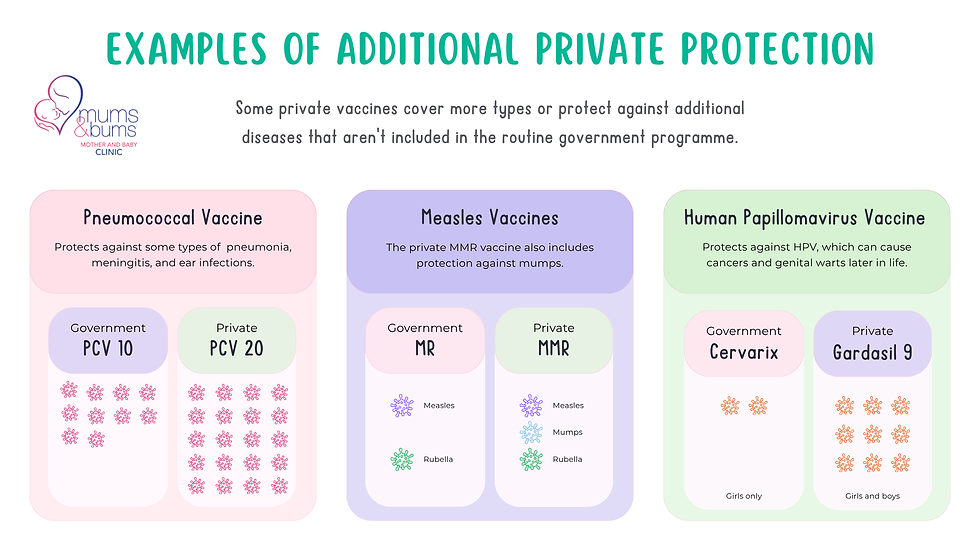
South Africa's government programme currently uses PCV 10, a vaccine targeting 10 types of pneumococcal bacteria. At Mums & Bums, we offer PCV 20, which targets 20 types.
Why does that matter? There isn't just one type of pneumococcal bacteria. Different types can cause illness, and a vaccine can only directly target the types it contains.
The benefit of PCV 20 is that it targets more types of pneumococcal bacteria. This offers the potential for broader protection against pneumococcal disease, although it doesn't mean twice the protection or protection against every cause of pneumonia or meningitis.
The Measles Vaccine Also Protects Against Mumps and Rubella
Measles vaccination is another area where you might notice different names on your child's vaccine record.
The government programme now uses MR, which protects against:
Measles
Rubella, also called German measles
This is an important update. In older schedules, the government only offered measles vaccination, but rubella protection is now included in the routine programme.
Private clinics can also offer MMR, which protects against three illnesses:
Measles
Mumps
Rubella
The additional protection here is against mumps. Although mumps is often associated with swollen cheeks and glands, it can occasionally cause complications, including meningitis, hearing problems and inflammation of the testicles.
At Mums & Bums, our schedule includes a measles vaccine and subsequent MMR vaccination. This means the protection included at each appointment may differ from the government programme, with the appropriate doses planned as part of the complete course.
Private HPV Vaccination Offers Broader Coverage for Boys and Girls
Human papillomavirus, or HPV, is a common virus. Certain types can cause cancers later in life, while others cause genital warts. South Africa's government school vaccination programme offers one dose of Cervarix free to eligible girls, including those attending participating public and private schools. Cervarix targets HPV types 16 and 18, which cause most cervical cancer cases.
The government previously used a two-dose schedule but changed to a single-dose programme following research showing that one dose provides strong protection for most healthy girls. A second private dose is therefore not routinely required. Children with weakened immune systems, including those living with HIV, may need additional doses.
HPV vaccination is something you should consider for sons as well as daughters.
At Mums & Bums, we offer Gardasil 9 to both boys and girls. While the government's Cervarix vaccine protects against two HPV types, Gardasil 9 targets nine, including those responsible for most genital warts and several HPV related cancers.
We follow the recommended two- or three-dose Gardasil 9 schedule, depending on the child's age and medical history, to provide the protection supported by the vaccine's approved dosing guidelines.
The difference isn't that the government HPV vaccine doesn't work. It offers valuable protection. Gardasil 9 targets additional HPV types, and private vaccination makes it possible to vaccinate boys who aren't currently included in the government school campaign.
Why should boys get the HPV vaccine?
HPV doesn't only affect girls. In boys and men, the virus can cause genital warts and certain cancers, including cancers of the penis, anus and throat. Vaccinating boys helps protect them against these illnesses and reduces the risk of spreading HPV to others.
Since South Africa's routine government HPV vaccination programme currently focuses on girls, boys can access this protection privately.
Which Extra Vaccines Can My Child Get Privately in South Africa?
So far, we've looked at vaccines where the private option may provide broader protection against a disease. But the private vaccine schedule also offers protection against additional diseases that aren't covered by the public childhood programme.
These are some of the reasons parents choose to follow a private vaccination schedule.
Extra Protection Against Meningitis
Some of the bacteria that cause meningitis are already covered by routine government vaccines. However, the government schedule doesn't include vaccines against meningococcal disease.
Meningococcal disease can cause meningitis or a serious bloodstream infection. It can become life-threatening very quickly, which makes vaccination particularly valuable.
At Mums & Bums, we offer two additional meningococcal vaccines:
Bexsero protects against meningococcal group B.
MenQuadfi protects against meningococcal groups A, C, W and Y.
These vaccines protect against different groups of meningococcal bacteria, which is why one doesn't replace the other. Neither vaccine prevents every cause of meningitis, and the appropriate vaccination course depends on the child's age and vaccine history.
These additional meningococcal vaccines are not included in South Africa's routine government childhood schedule.
Chickenpox and Hepatitis A Vaccines
Chickenpox and hepatitis A are two very different infections, but both can sometimes cause serious illness. Neither vaccine is included in South Africa's routine government childhood vaccination schedule, although both are available privately.
Chickenpox vaccine
Chickenpox is sometimes brushed off as an inevitable childhood illness, but it isn't always harmless. Chickenpox can occasionally lead to bacterial skin infections, pneumonia and other complications.
Vaccination reduces the risk of chickenpox and helps protect against more serious illness.
Hepatitis A vaccine
Hepatitis A is a viral infection affecting the liver. It spreads mainly through contaminated food, water, or close contact with an infected person.
Vaccination helps prevent hepatitis A infection and is particularly useful because children can spread the virus even when they don't appear sick. Vaccination offers protection against an infection that families might not otherwise think about until there's an exposure or outbreak.
Seasonal Influenza (Flu) Vaccine
Flu isn't always just a few days of coughing and a runny nose. Influenza can cause serious illness, particularly in younger children and those with certain medical conditions. Flu viruses also change over time, which is one reason seasonal vaccination is recommended.
Influenza vaccination isn't routinely provided to every child through the government childhood programme, although publicly funded vaccines are available for selected risk groups.
Unlike most of the routine childhood vaccines, influenza vaccination is generally recommended every year. Children receiving it for the first time may need an additional dose, depending on their age and vaccination history.
If you're unsure whether your child has received the vaccines available beyond the routine government programme, we can review their records and discuss the additional options.

Why Are Private Baby Vaccines More Expensive in South Africa?
Let's talk about the question that probably brought you here in the first place. Why does private vaccination cost so much when government vaccines are free? There are several reasons, and they're not all about the consultation fee.
First, Private Clinics Purchase Their Own Vaccine Stock.
Government vaccinations are paid for through public health funding, allowing children to receive routine vaccines without paying at the appointment. Private clinics purchase vaccines from suppliers, and some products can be expensive, particularly those offering wider coverage or protection against additional diseases.
Second, Private Vaccination Offers More Vaccines and Better Coverage.
A family choosing a broader private schedule is paying for products such as Bexsero, MenQuadfi, chickenpox. and hepatitis A. Vaccines that aren't included in the routine government programme.
That means the cost difference isn't always between two equivalent vaccines. Sometimes you're comparing different vaccines and the diseases they protect against.
Third, There Are Consultation and Administration Costs.
Both government and private clinics are expected to follow proper vaccine storage, handling, and administration standards. These safety requirements aren't exclusive to private care.
At Mums & Bums, our vaccine appointments are also allocated at least 30+ minutes, so we can review your child's vaccination record, explain the vaccines being given, and discuss any additional protection you may want to consider.
The cost reflects both the vaccines selected and the professional care provided during the visit.
Does Medical Aid Pay for Private Baby Vaccinations?
Some medical schemes cover routine childhood vaccinations, while others may also contribute towards additional private vaccines. It depends on your scheme, your benefit option, and whether the vaccine is covered through a preventative care benefit, day-to-day benefit, or another provision.
Certain vaccines may need to be paid for privately, even if your medical scheme covers other childhood immunisations. Before booking, check your benefits and ask whether the vaccine and the consultation or administration fee are covered.
If you're comparing costs, it also helps to understand which vaccines are included in the quoted price.
Not sure what your medical aid covers or what your child's vaccination appointment might cost? Contact Mums & Bums, and we'll help you understand your options.
Can I Get Government Vaccines and Only Pay Privately for the Extras?
Yes! You can continue with your child's routine government vaccinations and choose additional private vaccines, such as meningococcal, chickenpox, or hepatitis A vaccines. This gives you the option of accessing additional protection without paying for an entirely private vaccination schedule.
The important part is making sure your child's existing vaccinations and any new vaccines work together.
What If My Child Has Already Had Government Vaccines?
Not every vaccine can be swapped for another brand. Some products can be used within the same vaccination course, while others have different recommendations depending on your child's previous doses.
For example, a child who has already received a pneumococcal vaccine through government care doesn't automatically need to restart the entire course privately.
At Mums & Bums, we can review your child's Road to Health booklet, check what's already been given, and discuss which additional vaccines may be appropriate.
If your child is behind on their routine immunisations, our missed baby vaccinations and catch-up guide explains what happens next.

Already using government vaccines but interested in additional protection? You don't need to start again. We'll help you understand which private vaccines may still be appropriate.
Why Do Different Private Clinics Use Different Vaccination Schedules?
If you've compared vaccination schedules from two private clinics, you might have noticed that they don't look identical. That doesn't always mean one is wrong. Different vaccine brands can have different recommended courses and intervals. Clinics may also arrange appointments differently according to the vaccines they offer and the child's previous vaccinations.
What's important is that your child receives the appropriate vaccines, completes the recommended course and follows the correct intervals and age requirements.
The aim isn't to tick off dates on a chart for the sake of it. It's to make sure your child receives the right protection at the right time.
Is Private Vaccination Worth the Extra Cost for My Child?
For many families, the wider range of protection available privately is a good reason to consider the additional cost. Government vaccination already protects against many serious childhood diseases. That shouldn't be underestimated. But the government programme doesn't include every vaccine available in South Africa, and it doesn't always use products that cover the greatest number of bacterial or viral types.
Choosing private vaccination can mean protecting your child against additional diseases and having more choice over their vaccination plan.
Does that mean every child needs every additional vaccine? Not necessarily.
Different children have different health needs, and families have different budgets. Some additional vaccines may be particularly relevant depending on a child's health, exposure risks, and previous vaccinations.
What I would encourage parents to do is understand the options before ruling them out purely because they're not included in the government programme.
A vaccine being optional in the public schedule doesn't mean the disease it protects against isn't important or deadly.
If you do choose private vaccination, the benefit should be clear. You should know exactly which protection your child is receiving and why it has been recommended.
Let's Review Your Child's Vaccination Options
At Mums & Bums Mother and Baby Clinic in Centurion, we offer routine and additional childhood vaccinations, including Prevenar 20, meningococcal vaccines, MMR, chickenpox, hepatitis A, seasonal flu and Gardasil 9.
Whether you're planning your baby's first private vaccines, considering additional protection or combining government and private appointments, we're happy to help. Bring your child's Road to Health booklet or vaccination record, and we'll go through what's already been given, what may still be needed, and which additional vaccines are available.
Book Your Child's Vaccination Appointment Online, or take a look at our baby vaccination services in Centurion to learn more.

Frequently Asked Questions About Government and Private Vaccines in South Africa
Are government baby vaccines free in South Africa?
Yes. Routine childhood vaccines are provided free at government clinics in South Africa. Private clinics charge for vaccine products and their services, with costs depending on the vaccines given and the additional protection selected.
Does the government give Prevenar 20 in South Africa?
No. South Africa's routine government programme currently uses PCV10, which targets 10 types of pneumococcal bacteria. Prevenar 20 is available privately and targets 20 types, offering broader protection against pneumococcal disease.
Does the government give MMR vaccines in South Africa?
The government routine programme uses MR, which protects against measles and rubella. Private clinics can offer MMR, which adds protection against mumps. Both vaccines protect against measles and rubella, but MMR covers an additional disease.
Which additional baby vaccines are only available privately in South Africa?
Additional vaccines commonly offered privately include meningococcal vaccines, chickenpox and hepatitis A vaccines. These aren't routinely included in the government childhood vaccination programme. Private clinics may also offer products with broader coverage, such as Prevenar 20.
Can boys get the HPV vaccine in South Africa?
Yes. Boys can (and should) receive HPV vaccination privately in South Africa. The government school programme currently provides free HPV vaccination to eligible girls, while private clinics such as Mums & Bums offer Gardasil 9 to both boys and girls.
Do I need to repeat government vaccines when switching to a private clinic?
Usually not. Vaccines already received through government care generally count towards your child's vaccination history. A healthcare professional should review their records before deciding whether any additional doses or different vaccine products are needed.
Does medical aid cover private baby vaccines in South Africa?
Many medical schemes cover private childhood vaccinations, either through preventative benefits or available savings. Cover depends on your scheme and benefit option. Before booking, check whether the vaccine, consultation, and administration fees are included.
Can I book only the additional private vaccines at Mums & Bums?
Yes. You don't have to follow an entirely private schedule to access additional vaccines. At Mums & Bums in Centurion, we can review your child's vaccination record and discuss which additional vaccines may be appropriate.
Sr Samantha Pieterse is a registered nurse and midwife and the founder of Mums & Bums Mother and Baby Clinic in Centurion. She provides childhood vaccinations and family healthcare, helping parents understand their options and make informed decisions about their children's health.
This article was reviewed against the 2026 South African Vaccine Helpline schedule, Department of Health guidance, and relevant vaccine product information.



Comments