
Can You Give Panado and Nurofen Together to a Baby or Child? (South African Guide)

Updated: Jan 28

Few things are as stressful as a baby or child who’s in pain or running a fever, especially in the middle of the night when you’re tired and just want to help them feel better. Many parents reach for Panado first, but when symptoms don’t settle, the next question is almost always: Can Nurofen be given as well?
If you’ve ever found yourself standing in front of the medicine cupboard wondering whether Panado and Nurofen can be used together, you must be a parent. It’s one of the most common questions parents ask, and unfortunately, online answers are often confusing or based on overseas advice.
In this guide, we’ll walk through what parents in South Africa need to know about using Panado and Nurofen for babies and children, when it may be appropriate, when it’s best avoided, and how to use these medicines safely.
Can You Give Panado and Nurofen Together?
In some situations, Panado and Nurofen can be used together for babies and children, but only when they’re used correctly and for the right reasons. These medicines work differently in the body, which is why healthcare professionals sometimes recommend using both when pain or fever isn’t settling with one alone.
That said, giving them together isn’t always necessary, and it isn’t something parents should do routinely without understanding when it’s appropriate, how to space doses, and when it’s safer to stop and reassess.
Is it safe to give Panado and Nurofen at the same time?
Safety depends less on the combination itself and more on how and when each medicine is given. Problems usually arise when doses are too close together, the same medicine is accidentally given twice, or age- and dosing-guideline requirements aren’t carefully followed.
For this reason, giving Panado and Nurofen together should always be done with a clear plan, including the correct doses for your child’s age or weight, enough time between doses, and careful tracking of what has already been given.
When doctors or nurses may recommend using both
Healthcare professionals may suggest using Panado and Nurofen together when a child’s discomfort or fever is not improving with one medicine alone, despite it being given correctly. This is most often considered during short periods of significant discomfort, such as a high fever that keeps recurring or pain that affects feeding, sleep, or hydration.
In these situations, the goal isn’t to give more medicine, but to improve comfort safely while the child recovers. This approach is usually recommended for a limited time, with clear instructions on dosing and spacing, and regular reassessment to decide whether both medicines are still needed.
When you should NOT give Panado and Nurofen together
Panado and Nurofen should not be given together if your child’s symptoms are mild and settling with one medicine on its own. Using both routinely or “just in case” increases the risk of dosing errors without offering any real benefit.
They should also not be combined if you’re unsure when the last dose was given, if doses have already been missed or doubled up, or if your child is outside the recommended age range for Nurofen. In these situations, it’s safer to pause and seek advice rather than add another medicine.
If a child’s pain or fever is not improving at all despite careful dosing, giving more medicine is not always the answer. It’s a sign that medical advice is needed rather than continued combination dosing.

Panado vs Nurofen: What’s the Difference?
Panado and Nurofen are both commonly used to help children feel more comfortable when they’re unwell, but they’re often chosen for slightly different reasons. Parents are frequently unsure which one to use first, or why one may seem to work better than the other for a particular child or situation.
Understanding the basic difference between Panado and Nurofen can make it much easier to decide which medicine is most appropriate, and when using just one may be enough.
What Panado is usually used for
Panado contains paracetamol, a medicine commonly used to relieve pain and reduce fever in babies and children (and adults). It does not treat the cause of an illness, but it can help a child feel more comfortable while their body recovers.
Parents often use Panado for things like fevers, teething discomfort, headaches, sore throats, or aches that come with common childhood illnesses. It’s usually the first medicine parents reach for, especially in younger babies, because it’s gentle when used correctly and suitable for a wide range of ages.
What Nurofen is usually used for
Nurofen contains ibuprofen, which helps with pain and fever and also reduces inflammation. Because of this, it’s sometimes helpful to link discomfort to swelling or inflammation rather than to fever alone.
Parents often find Nurofen useful for things like muscle aches, inflammation-related pain, ear pain, or discomfort that doesn’t seem to settle with Panado on its own. It’s commonly used in slightly older babies and children, depending on age, and may feel more effective in certain situations because of its anti-inflammatory action.
Why some children respond better to one than the other
Parents often wonder whether Panado or Nurofen is “stronger,” but the difference usually comes down to what’s causing the discomfort, not the strength of the medicine. Some children respond well to Panado when fever or general aches are the main issues, while others seem to improve more with Nurofen when inflammation or swelling is a bigger factor.
Children can also respond differently based on their individual bodies, the type of illness they have, and how their symptoms change over time. This is why one medicine may seem to work better in one situation, while another is more helpful in another, and why switching or reassessing can sometimes make sense rather than assuming one option is always better.
How to Alternate Panado and Nurofen Safely
Parents often hear advice about “alternating” Panado and Nurofen, but it’s not always explained clearly. Alternating doesn’t mean giving medicines randomly or more often. It means using them in a structured, planned way to manage symptoms while reducing the risk of dosing errors.
Understanding how alternating works, and when it’s appropriate, can help parents feel more confident and avoid common mistakes when caring for an unwell child.
How many hours between Panado and Nurofen?
Panado and Nurofen can be given at the same time in certain situations, but doing so means you cannot give another dose of either medicine for several hours afterwards. Because of this, giving both together is often not the most practical first step for parents managing symptoms at home.
In most cases, it’s safer and more helpful to give one medicine first, then wait to see how your child responds before adding another. This makes it easier to track what has been given, reduces the risk of dosing errors, and prevents giving your child more medicine than they actually need. If symptoms return or don’t settle after an hour or so, the next dose can then be planned carefully.
If you’d like a clearer breakdown of how different South African pain and fever medicines fit together, including combination products and dosing rules, you can read our step-by-step guide to alternating children’s pain and fever medicine here.
Example dosing schedule parents can follow
A simple way to approach alternating is to start with one medicine, then only add the second if symptoms return or don’t settle between 1 and 4 hours.
For example, you might give Panado first and monitor your child's response. If discomfort or fever returns later, Nurofen can be used as the next dose rather than waiting for 8 hours to repeat Panado. From there, doses can continue to alternate only if needed, always allowing enough time between each medicine and keeping a clear record of what was given and when.
This step-by-step approach reduces confusion and prevents overlapping doses.

Common mistakes parents make when alternating
One of the most common mistakes parents make when alternating Panado and Nurofen is giving doses too close together, especially when a child is uncomfortable and emotions are running high. While this usually comes from a place of wanting to help quickly and isn’t “wrong,” it can leave you with no options later if symptoms return before the next dose is due.
Another frequent issue is losing track of what was given and when, which increases the risk of accidentally repeating the same medicine instead of alternating. This is why writing down doses or using reminders can be so helpful when a child is unwell.
Parents may also feel pressure to alternate medicines even when symptoms are mild or already improving. Alternating isn’t meant to be routine. It’s a short-term strategy for specific situations. If discomfort is settling with one medicine alone, adding another doesn’t usually provide extra benefit and can increase confusion instead of relief.
Can You Give Panado and Nurofen to Babies?
When it comes to babies, questions about pain and fever medicine naturally feel more stressful. Panado is commonly used in babies when given correctly, but Nurofen is not routinely recommended for babies.
Because of this, decisions around using Panado and Nurofen in babies need extra care and an understanding of when professional advice is essential, rather than relying on general dosing rules.
Age limits for Panado in babies
Panado is commonly used in babies when the correct baby formulation is used, and guidance is carefully followed. It’s often the first option recommended for pain or fever in younger babies because it can be given across a wide age range.
What matters most is making sure Panado is given in a way that matches your baby’s age and weight, and that doses are spaced correctly. If you’re ever unsure, especially with very young babies, it’s always best to check before giving another dose.
Age limits for Nurofen in babies
Nurofen is not routinely recommended for babies under two years of age unless the dose has been specifically worked out by a healthcare provider. This is because babies process medicines differently, and using Nurofen in very young children requires careful consideration rather than general age-based assumptions.
For this reason, parents should avoid giving Nurofen to babies unless clear guidance has been provided for their child. If a baby is very young or symptoms are concerning, it’s safer to seek advice rather than try to manage discomfort with additional medicine.
What to do if your baby is under 3 months
If your baby is under three months old and has a fever or seems unwell, it’s important to ALWAYS seek medical advice rather than manage symptoms at home. At this age, even mild symptoms may require proper assessment, and home remedies are not the first step.
Nurofen should not be given to babies under three months, and Panado should only be used if you’ve been specifically advised to do so. If you’re worried about your baby’s temperature, feeding, behaviour, or overall comfort, always have them assessed by a healthcare professional, as recommended by the South African Department of Health.

Panado, Nurofen, Ponstan & Other Pain Medicines: What Can Be Combined?
Many parents recognise the names Panado, Nurofen, and Ponstan, but feel unsure about which of these medicines can be used together and which should not be mixed. This uncertainty is common, especially when different medicines are used for pain, fever, or inflammation, and advice online feels inconsistent.
Understanding how these medicines fit together and when combination use needs guidance can help parents make safer decisions when managing a child’s discomfort.
Can you give Panado and Ponstan together?
Panado and Ponstan (or Ponac) can be used together in certain situations, but this should usually be done only when a healthcare provider has advised it. Using both medicines isn’t typically necessary for everyday pain or fever, and combining them without guidance doesn’t always add extra benefit.
Ponstan is generally prescribed for specific types of pain and isn’t meant to be added routinely on top of Panado. If Ponstan has been recommended for your child, it’s important to follow the advice given and avoid mixing medicines unless you’re clear on how and when they should be used together.
Can Panado be given with other pain or fever medicines?
Whether Panado can be given with another pain or fever medicine depends on the other medicine. Some combinations are appropriate in certain situations, while others should not be used together. This is why it’s important not to assume that medicines can be mixed just because they’re commonly used or available over the counter.
If you’re ever unsure, it’s best to pause and check before combining medicines on your own.
Medicines that should NOT be mixed with Panado or Nurofen
Panado and Nurofen should not be mixed with other pain or fever medicines unless a healthcare provider has specifically advised it. This includes medicines used for pain, fever, or inflammation, even if they’re familiar household names.
For example, Panado or Nurofen should not be combined with medicines such as Ponstan, Empaped, or other pain or fever products that may already contain similar ingredients. Mixing these medicines increases the risk of double-dosing or unnecessary overlap without improving comfort.
If you’re unsure whether a medicine can be used alongside Panado or Nurofen, it’s safer to pause and check rather than assume they can be combined.
When to See a Nurse or Doctor for a Fever Instead of Giving Medication
While medicines are often used to improve comfort at home, they’re not a substitute for medical assessment when symptoms aren’t settling or when something doesn’t feel right. In some situations, it’s more important to have your child checked instead.
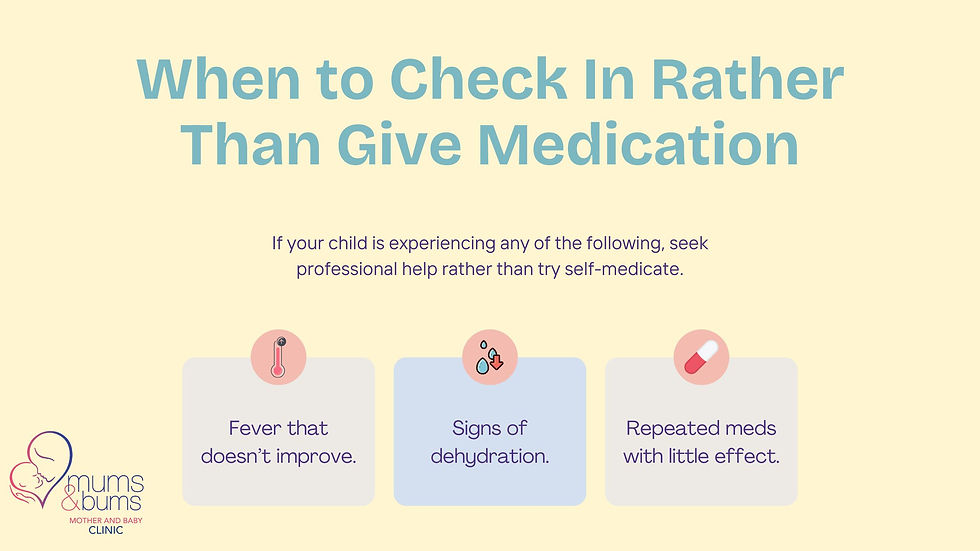
Fever that doesn’t improve
If your child’s fever keeps returning or doesn’t improve despite using medicine correctly, it’s a sign that the cause of the illness may need to be assessed. Ongoing fever can be more important than the number on the thermometer, especially when it’s affecting your child’s behaviour, feeding, or sleep.
Signs of dehydration or serious illness
Seek medical advice if your child is drinking very little, has fewer wet nappies or trips to the toilet than usual, seems unusually sleepy, floppy, or difficult to wake, or if you’re worried about their breathing, colour, or responsiveness.
Repeated dosing with little effect
If you find yourself needing to give repeated doses with very little improvement, it’s a good time to pause and reassess. Needing ongoing medicine without clear relief can be a sign that your child needs medical input.
If you’re unsure whether your child needs to be seen, or you’d like guidance on whether symptoms are within the normal range, at Mums & Bums, we can help you decide on the next best step. Sometimes an assessment makes all the difference.
A Little Reassurance for Parents
When your child is uncomfortable or unwell, it’s completely normal to want to help them feel better as quickly as possible, and to feel unsure. Medicines like Panado and Nurofen can play a role when used thoughtfully, but they’re only one part of caring for a sick child. How your child looks, behaves, feeds, and responds is just as important as giving medication.
If symptoms aren’t improving, or something doesn’t feel right, it’s okay to pause rather than push on with more medicine. In those instances, a quick conversation can clarify things.
You can contact the Mums & Bums in Centrion if you’d like guidance on whether symptoms are within the normal range or whether your child should be seen.
And if you’d feel more comfortable having your child assessed, you’re welcome to book an appointment online at Mums & Bums. Sometimes reassurance is enough, and sometimes an examination provides the peace of mind you are looking for.
Quick Answers Parents Ask All the Time
Can I give Panado and Nurofen together for a fever?
Yes, Panado and Nurofen can be used together for fever, but this isn’t always necessary. It’s usually better to start with one medicine and see how your child responds before adding another, rather than giving both automatically.
Which is better for teething pain?
Panado is often the first choice for teething pain, especially in younger babies. Some children respond better to Nurofen if inflammation seems to be contributing to discomfort, but this depends on the child and their age.
Can I alternate every 2 hours?
No. Alternating every 2 hours is not recommended and increases the risk of dosing mistakes. Alternating should be planned carefully, with enough time between doses, rather than on a rushed schedule.
Is Nurofen stronger than Panado?
Neither medicine is “stronger” overall. They work differently, and one may seem more effective than the other depending on what’s causing the pain or fever. Response varies from child to child and situation to situation.
How long does Panado take to work?
Panado usually starts to work within 30 to 60 minutes. If there’s little improvement after this time, it’s worth reassessing symptoms and then considering giving additional medicine.




Comments